


Aircraft Carriers: The Most Formidable yet Most Vulnerable Military Platform By - Gp Capt TP Srivastava

INTRODUCTION (Relevance for India)
Ongoing war initiated by Israel and USA has huge lessons for India. One of the most important is Utility of Aircraft Carriers in our context.
In short 'Aircraft Carriers are Weapon Platform of Past'. Kindly read the article I wrote about three years ago specifically identifying the role of these white elephants in our scenario.

My first article on survivability of aircraft carriers against a nation having formidable air power was in 1981. Latest advent of long range anti shipping hypersonic missile has reduced the survivability percentage by few more notches.
Iran having no worthwhile air power has forced to push one of the most formidable carrier at least 1000-1500 km from its territory because Iran has long range anti shipping missile. This is in spite of the fact that US CBG has multi-layer protection, which we do not have. We lack 'eyes in the skies' of the same/comparable class as E-2D etc.
In any future conflict with Pakistan, possibility of China providing YJ-21 class of anti shipping hypersonic missile to Pakistan cannot be ruled out. Planners will have to take that into account.
Long standing doctrine of SEA CONTROL by surface ships viz CBG is no longer valid. Instead a country like ours with Indian Ocean and Arabian Sea should consider SEA DENIAL by creating large nuclear submarine fleet. Then and only then shall we be able to counter China and Pakistan.
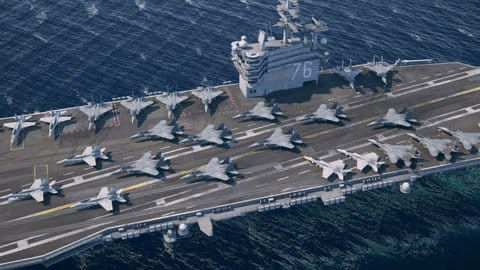
“Traditionally, naval ships have been painted a shade of dark gray. If the Gorshkov is purchased, the Indian Navy might make an exception and paint the ship white. For the aircraft carrier is bound to be the biggest white elephant in the navy's fleet.”
--Admiral JG Nadkarni
Former Chief of Naval Staff
2nd November, 2001
The Indian Navy's white elephant by Admiral JG Nadkarni
Excerpt:
“You have recently completed your bungalow and are on the lookout to hire some people for security. Pandu chowkidar has agreed to do the job along with his friend for about Rs 2,000 a month per person. But your good friend who has a security business steps in. Don't waste your money, he says. I have a surplus of these people. I can give you a couple free. But what about some electronic fencing and surveillance cameras? Before you know it he has sold you equipment worth a couple of lakhs.
India's imminent purchase of the Russian aircraft carrier Admiral Gorshkov comes pretty close to this illogical purchase.”

Background
In spite of candid opinion of a former CNS, Indian military went ahead and purchased the ‘white elephant’ at a huge cost. Another illogical acquisition from same country has been done recently; the ‘JUNK’ S-400 platform at a whopping cost of INR 39,000 Crore. If the amount spent on purchase of these platforms was instead spent on purchase of Submarines, Indian Military’s offensive capability to control affairs in Indian Ocean Region (IOR) would have been few notches higher. We are about to repeat same/similar mistake by deciding to invest in a platform which will never be used as operational platform.
We continue to ape China and western world. Before elaborating on ‘usefulness/uselessness’ of an Aircraft Carrier, it would be more appropriate to mention about Chinese Aircraft Carrier and Indian Aircraft Carrier operations during war.
There are four basic requirements for a CBG to be used in a genuinely offensive role (in addition to compliments of support ships and submarines), which I call QUAD (I coined this term in 1981);
· Dedicated Carrier Borne AEW/AWACS.
· Dedicated Air to Air Refuelling Capability.
· On board Strike aircraft with sufficient Radius of Action and weapon load.
· Airborne Surveillance Aircraft for Submarine Detection.

Chinese CBGs do not have any of the above. Hence to project Chinese CBGs as a threat in Indian Ocean region (IOR) is akin to day dreaming. From the east coast of China (say Shanghai) the distance to Bay of Bengal (Andamans for example) will be around 3800 km. China lacks the logistic capability to support a CBG at such distance. After entering Straits of Malacca, if it succeeds, CBG will be vulnerable to Su-30s and P8i in addition to our own CBG. Will China take that risk? Extremely unlikely!
China Centricity
Military strategists of India are busy talking about Chinese Aircraft Carriers. Third platform Fujian fitted with EMALS is doing limited sea trials. Can Chinese Navy bring its Carrier Battle Group in Bay of Bengal or Arabian Sea and from where? There are only four routes open for Chinese Navy to enter Bay of Bengal/Arabian Sea. Closest and fastest approach will be through Straits of Malacca. Sunda, Lombok and Torres straits are also theoretical possibility. Chinese CBGs as on date are, therefore not capable of threatening Indian interests in IOR in foreseeable future.

American CBGs are the only genuine offensive sea control entities in the world. Chinese Navy is unlikely to acquire matching capability even in next 30-40 years. Chinese CBGs can only operate around South China Sea and neighbourhood. Even against Taiwan Chinese CBGs will not be able to operate in offensive role because Taiwanese air power has modern land based strike elements, which will pose grave threat to Chinese carriers.
Hence to acquire yet another aircraft carrier on the pretext of challenging/meeting Chinese CBG threat is an irrational conclusion based on presumptuous imagination.
Indian Aircraft Carrier Operations during War
Indian aircraft carrier INS Vikrant was used during 1971 war in eastern theatre. Indian Military could deploy and use INS Vikrant because there were no Air Power elements in erstwhile East Pakistan courtesy ‘superior’ wisdom of Yahya Khan, who ordered withdrawal of PAF elements from East Pakistan. Hence Sea Hawks from INS Vikrant could operate with impunity. Such 100% sterile environment will never (r) never exist in foreseeable future against Pakistan in Arabian Sea.
For the reasons due to which Chinese CBGs cannot operate in IOR, Indian CBGs too cannot operate anywhere near South China Sea.
Status of Present Indian CBGs
Indian Military currently has two ‘operational’ aircraft carriers, hence we could create two independent CBGs. However Indian CBGs are devoid of first three elements of the QUAD discussed above. The only world class platform available is P8i, the fourth element of QUAD.
Capability of each one of these will now be placed for perusal of ‘informed’ decision makers.

1. Carrier Borne Aircraft. Current ac MiG 29K has extremely limited radius of action in strike role with maximum weapon load (280 km). In air defence role it has endurance of 90 minutes while deployed 200 km from carrier. Hence Carrier will have to be less than 200 km from Karachi to enable MiG 29K strike a target barely 80 km from the coast. Can it happen? Never!
PAF F-16s have a LO-LO-LO radius of action of around 550 km with two AIM9L or One Exocet. Which implies ‘ONE WAY’ reach of 1100 km. Exocet has a launch range of around 150 km. Hence a F-16 can engage a ship while the ship is about 12-1300km from Pak coast (Karachi). If Indian CBG approaches within 12-1300 km of west coast of Pakistan, PAF will launch a ONE WAY super saturated single radial strike with 16 F-16s. Eight F-16s will be equipped with AIM9L Air to Air missile (range 120 km) and ECM Pods. Remaining eight F16s will carry one EXOCET ANTI SHIPPING MISSILE. Assuming that first fourteen F-16s will be shot down, remaining two will launch their EXOCET targeting the carrier. Two Exocet hit will sink the carrier without any doubt. While PAF will lose sixteen F-16s and pilots, Indian Military would have lost two squadron worth of aircraft (32), nearly 1500 men and a capital ship.
It is being stated so candidly to let the decision makers know the actual operational capability/utilization of a CBG. What will be operational efficacy of Indian CBG operating farther than 1300 km from Pak coast?
Without doubt after Rafales are inducted strike and AD capability will be enhanced by few notches but even that would not enable CBG to operate in close proximity of Pak west coast.
For record; Above scenario has been wargamed at College of Airwarfare by me when I was Chief Instructor there.

2. Dedicated Carrier Borne AEW/AWACS. Currently CBGs neither have any fixed wing carrier borne AEW/AWACS having sufficient endurance nor is it likely to happen in the next 30-40 years. Without dedicated AEW/AWACS a CBG will be a ‘sitting duck’ against an adversary having formidable Air Power elements.
3. Dedicated Air to Air Refuelling Capability. Currently the capability does not exist.
4. Dedicated Surveillance Aircraft. P8i is the most modern surveillance platform and is available in sufficient numbers to provide round the clock surveillance to CBG.
5. Day/Night Operations. As on date Indian carrier operations can be carried out by day only. Even in 1971 carrier borne aircraft operated during day only.
Sea Control vs Sea Denial
The debate on sea control and sea denial is as old as the Navy. Effective sea control can only be carried out by a ‘fully equipped’ CBG. If any element is not available CBG becomes vulnerable. Having proved beyond reasonable doubt that Chinese CBG cannot enter IOR and operate against Indian interests, the next issue is sea denial.
Chinese Submarine fleet is huge (nearly 70) as compared to India (18). Indian submarine fleet is primitive. Not a single Air Independent Propulsion (AIP) capable conventional submarine is yet to join the fleet. Hence our sea denial capability is extremely limited and needs to be enhanced on priority.

Sea Control; An Outdated Concept
Nearly four years ago when hypersonic anti shipping missiles were not in picture, I had proposed that Indian Military needs three CBGs, hence four carriers; one for refit and three deployed operationally. In 2023 hypersonic anti shipping missiles have become a reality. China is the leader. Although it must be stated that claimed hypersonic anti shipping missile capability is yet to be proven in actual conditions. No known ballistic missile defence system will be able to intercept the incoming hypersonic missile. With use of Artificial Intelligence it will invariably lock on to the largest ship;The Aircraft Carrier.
In 2023 there is no point discussing battle of Coral Sea or battle of Midway to promote the case for acquiring aircraft carriers. For that matter even Falkland operations of 1982 are merely for records.
Surface ships have become far more vulnerable now than a decade ago. Classic CBG operations are no longer a feasible option against an adversary with formidable air power.
Conclusion
In order to genuinely control affairs in IOR, Indian Military needs to upgrade its submarine fleet, both in quantity and quality. Enhanced Sea Denial capability will ensure that China does not attempt any misadventure.
Acquiring more aircraft carriers will be counter productive because the platform will not have substantive operational use. Proposed investment in third aircraft carrier must be diverted to acquiring submarines on priority. As on date Chinese Navy submarine capability is miles ahead of Indian Military. The gap cannot be bridged overnight but firm and concrete steps, if taken will enable Indian Navy to guard IOR in a far more effective manner.

Aircraft Carriers are weapons of the past. What is the target envisaged for carrier borne aircraft and where? Our CBGs can operate only against Pakistan. PAF is and will remain a force to reckon with and Indian Carrier operating in Arabian Sea will be their prime target. Let us get existing Aircraft Carriers equipped with weapons and weapon platforms that will ensure safe operation. Neither of existing carriers with mere 45000 ton displacement is a truly strike carrier. Fujian of China is 80000 ton ship.
Indian Military must not fall into the ‘carrier race’. We must learn from mistakes of USSR, which entered the anti ballistic missile race with USA after USA’s STAR WARS programme was declared as operational (which never happened) and disintegrated. Technology was used as economic weapon. Let us not waste billions in creating white elephants.
When we talk about acquiring aircraft carrier, we should not discuss the cost of the carrier only. We should discuss the cost of CBG. While I do not have authentic data of cost of various ships/submarines, which will be required to form a CBG, A FAIR GUESS WOULD BE AROUND USD TEN BILLION, POSSIBLY MORE. Let us not join the ‘rat’ race.


Comments