


Victory India - A Key to Quality Military Leadership (2012) : Foreword, Prologue & Excerpts From the Articles

Date :- 02 October 2026
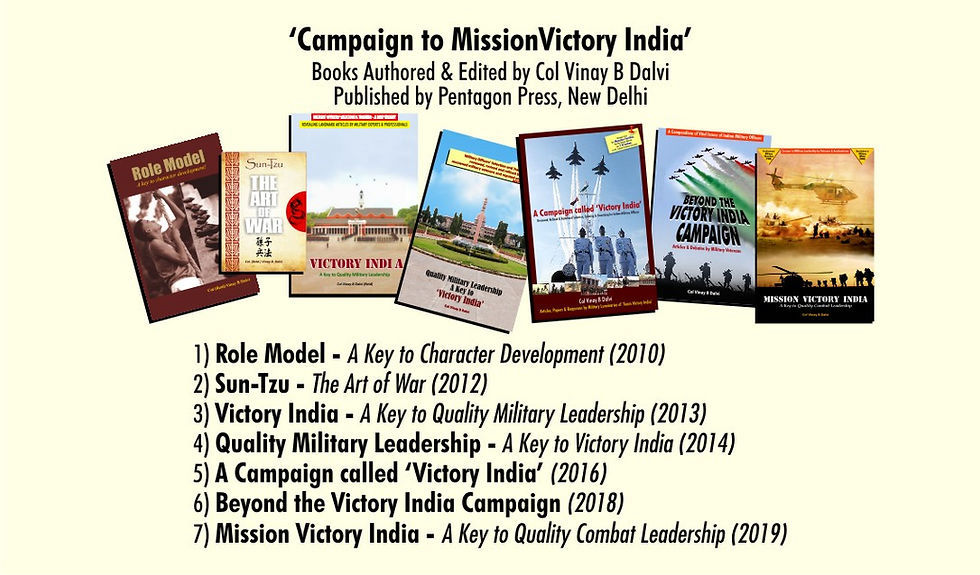
EDITOR'S NOTE : This book was Released in Oct 2012 at Air HQ by Air Chief Mshl NAK Browne ,CAS & Chairman COSC. It was painstakingly compiled after several personal interactions with all the authors who accepted the onerous responsibility of penning down their thoughts for posterity . Its the collective result of dedicated efforts by many for a noble cause . The book is ' An Eye Opener for the SSBs and our military academies ' . Its been fourteen years since it was released ,however, what was stated by so many committed authors hasn't apparently reached the concerned readers for whom it was meant even after 14 years ! This is evident on ground where nothing much seems to have happened. If this is the fate of the 2012 'volume one ' of the ' Victory India Campaign ' what would be the fate of four more volumes of 2014, 2016, 2018 & 2019 ,all dedicated basically to improve the quality of our military leadership by addressing the identified flaws, shortcomings and weaknesses in our selection and training systems for military officers.Hence, with a view to spread awareness about this volume one of Victory India Campaign MVI is publishing the
Essence of the Experts’ Views of the Contributory Authors ,which is the last chapter of the book . The Foreword to the book by late Maj Gen VK Madhok and the Prologue is also included . Team Victory India & MVI request readers to kindly peruse this article as a lot of what is stated remains relevant and valid today , even after 14 years ! We hope that through this endeavor the awareness about the reality on ground spreads and leads to some positive action on ground sooner than later! Victory India!

Col Vinay B Dalvi, Editor , Victory India Campaign & MVI
FOREWORD
1. Here is a book which deals with the selection process of officer candidates for the armed forces at the SSBs (Services Selection Boards) and with the training of selectees (Cadets) at their respective training academies. Selection criteria, tests and standards of judgment currently being used to assess candidates and initial basic training processes and syllabi of cadets at the academies have come in for much criticism and censure. Especially so, because of the recent cases of moral turpitude and Court Martials resulting there from—of at least half dozen serving general officers and cases of false and fraudulent means to gain recognition and awards. The steep increase of suicide rates of jawans and frequent officers-men confrontation are now a matter of deep concern. These unsavory incidents are now raising serious questions as to whether our systems are still valid and sound in keeping with crucial requirements of present and future battle field environment or are these outdated and require a thorough review by a group of experts. Col Vinay Dalvi’s book comprising articles and comments by various specialists and veterans addresses these issues in as comprehensive a manner as possible; that is, an analysis of the selection process followed with views on training at the NDA, IMA, OTA, Naval and Air Force academies.

2. Questions have been raised and considered regarding the methods in vogue for selection by GTOs (Group Testing Officers), Psychologists, Interviewing officers besides the screening tests. Are these officers sufficiently qualified to assess the potential of candidates? As regards training: articles by four ex-Commandants of the NDA besides the one from OTA—along with the views of psychologists, lecturers, medical and sports specialists and defense analysts are of special interest: Again, the point is, are these institutions providing the necessary environment to develop the potential of these cadets?
3. Some of the issues discussed are revealing and merit action to obviate the flaws, because the quality of current and future military leadership will determine the effectiveness of our armed forces—whether they will be in a position to check and confront China or in a two front war with China-Pak nexus.
Of the many issues discussed in the book I find three to be of particular interest:
a) Firstly, there is a total mishmash between the qualities in which candidates are assessed at the SSBs; those which the training academies try to inculcate in the cadets during training and finally, those in which the serving officers are assessed in their ACRs (Annual Confidential Reports). Obviously, someone has to decide as to what character qualities we are looking for in our military leaders. The Defense Minister and the three Chiefs would do well to correct this serious anomaly.

b) Secondly, the weightage which is now being given to academics, especially at the NDA; is our intention to produce Soldiers of character or Professors? The academics to training ratio is officially supposed to be 70:30. Unofficially it seems probable that it is the opposite, 30:70. Could we review and draw a clear line?
c) Finally, as brought out in one of the articles, there is an absolute and imperative necessity of periodic review—say, once a year, and complete inspection of our academies by an independent Governing Body comprising serving officers, veterans and other experts, reporting directly to the Chiefs of Staff committee as one of the senior authors has mentioned.
4. Today, the Soldier feels abandoned! Senior hierarchies are unable to stand up to political leadership or interact with the media. Military leadership stands sidelined. The Indian democratic system has yet to perceive the changes and shift from a colonial to a democratic way of command. And nothing can be done about that by the leadership of the Armed Forces except stand up firm on the strength of its character. The bottom line is that even technology cannot replace character. Best of Armies will always be led by men of character and not mere knowledge. The environment has changed. Today, men are much better educated. That will always be so in a democracy. Their leaders (Military) therefore will have to have much higher intellectual, physical and moral standards to be in a position to lead them. Such issues will have to be kept in view while revisiting our SSBs and training academies. This book has touched on a serious subject and it has been achieved by authors who have given committed thought to it and have articulated remarkably well. It is a great treat on military leadership and is good food for thought for all students of leadership—serious or casual. And those directly concerned with selection and developing military leadership will do well to read it.
13th Oct, 2012 Maj Gen V K Madhok, AVSM, VSM (Retd)
Ex NDA, 1st Course (JSW)
Author: ’Battlefields of the early 21st Century’,
‘Space: Profiles of the Future and Repowering
National Security’
Research fellow: India Surrounded and
Engaged.
Prologue
‘Role Model’ was the first ever wake-up call, bringing into focus the state of affairs related to officers’ selection and training. The wide acceptance and appreciation of this book by the entire defence hierarchy including the Raksha Mantri, Service Chiefs and Army Commanders encouraged me to proceed further.
To effectively address the issues brought out, it was imperative that a collective, meaningful and effective consensus must be reached by the three Services. The army being the biggest stake holder, it needs to shoulder this responsibility and take the lead. In order to facilitate the same and to also add a sense of urgency at the national level, letters were sent in this connection to the Prime Minister, Raksha Mantri and all concerned of the Armed Forces on ‘’The Quality Officer Leadership Crisis of the Armed Forces’’ and also on the way out.
Two landmark articles, ‘’Grim Portents’’ and ‘’Unleashing the UPSC’’ by Maj Gen Raj Mehta, published in the Geopolitics magazine, Nov. 2011 & Jan. 2012 issues respectively gave the subject the required priority and boost.
It is a matter of procedure and practice that the uniformed fraternity is neither inclined nor encouraged to positively interact with retired veterans on such matters. Hence the developments and progress taking place on these issues are rarely presented to the committed and deeply concerned veterans. But with all due respect to the requirements of service, the subject cannot be glossed over because of its deep relevance to the nation; and it gladdens me that the press has begun to take notice and write about the issue.

This book ‘’Victory India’’ is a rare compilation of articles, views, comments and recommendations of specialists and experts of various fields connected with the entire selection and training system of our officer cadre. Distinguished veterans conscientiously made efforts to honestly express their opinions. This combined, coordinated and cohesive effort is being offered selflessly to the nation and the Armed Forces with a sense of concern and responsibility to the uniformed fraternity; of which the veterans are an integral part. The insight is rich, and diverse, and those with responsibilities stand to greatly benefit.
It is left to the highest leadership in the country - Political, Bureaucratic and Military to take note of the glaring shortcomings and drawbacks confronting the Nation and the Armed Forces, and search for solutions. This by no means suggests that this book is a magical solution to all our current problems. However, it does contain the necessary ingredients to formulate a practical, meaningful and effective course of action.
There is an earnest and fervent prayer that better sense and judgment will prevail; and that an appropriate, befitting, and speedy action will be taken. May the issues be addressed and resolved, thus strengthening the ‘’military leadership’’ - the most important principle of war for any nation.
A serious initiative is apparently long overdue, and as Martin Luther King Jr. said, ‘’A genuine leader is not a searcher of consensus but a molder of consensus’’.
Pune, 2 October 2012 Col Vinay B Dalvi (Retd)
Excerpts from the Articles
An Eye Opener for the SSBs & Academies :
Essence of the Experts’ Views
Col Vinay B Dalvi (Retd)
Having deeply studied all the views of the authors on various aspects raised in the book and more so on the NDA, I find that the following excerpts of the articles give a crisp and quick read on what must be the immediate steps on which the leadership at all levels, and particularly the NDA, must act upon. When combined, all these points draw attention to the urgency to the need for a change. All the contributors mean business and this must convince us to seize ourselves of the seriousness of the issue. As a nation seeking solutions, we can ignore the likes of these only to our peril.
I strongly recommend that the contributions in the form of articles and responses must be studied with great concern—both as an opportunity to deeply introspect, and for students of leadership to understand the minds of the excellent thinkers of our times, with expertise in selection and training.

Admiral Arun Prakash (Retd), PVSM, AVSM, VrC, VSM
A) “To do full justice to the onerous appointment of Commandant NDA, it must be filled by a senior officer of good standing, who brings vision and zeal to the job, and serves for a reasonable tenure. The current viewing of the appointment as a convenient parking slot or pre retirement sinecure must end.”
B) “The laying of a sound moral foundation and inculcation of leadership qualities should be made a key result area in the academy’s curriculum.”
C) “There is need for an all encompassing review of NDA curriculum with expert evaluation to find the right balance between physical and intellectual standards to be attained with correct proportion of training effort to each.”
D) “The UPSC/SSB selection processes are outdated and therefore failed to identify the right material for induction. An objective evaluation of current selection methodology with other Armed Forces may throw up useful pointers.”
Vice Admiral S C S Bangara (Retd), PVSM, AVSM
A) “The impact of introducing an under graduate syllabus alongside a demanding military schedule was the root cause of many aberrations that crept into the lives of the cadet. This was aggravated by the loss of academic stalwarts, mentors for a generation of cadets, due to pay-commission’s stand on their pay and allowances. The inability of UPSC to provide their replacement under revised guidelines proved disastrous for NDA.”
B) “The academic content of under graduate syllabus demanded 70% of the time allotted for training. Military training was thus manipulated insitu, by the senior hierarchy, depending on the predilections of leadership; adhocism became a rule than an exception. In consequence both academic and military training suffered since no one was really accountable for the quality of the output.”
C) “It is now necessary that the Chiefs of Staff Committee (COSC) assumes direct responsibility through an effective governing body or council which oversees the quality of training on a regular basis.”
D) “No one brought home the ill effects of the “All is well” syndrome better than the producer of “Three Idiots”, reminding me of the unfinished agenda of NDA.”

Lt Gen Arun Chopra (Retd), AVSM
A) “The officer like qualities (OLQ) on which the services selection boards base their selection are many but a few which need a greater emphasis in the changing conflict scenario are: (i) A leader needs to be a thinker. (ii) Honest and upright officers, with a high sense of professional and personal integrity. (iii) He has to be physically and mentally fit. (iv) He should be emotionally stable. (v) He should have the courage and drive. The officer thus has to be a dynamic leader not accepting status quo.”
B) “Our selection system though comprehensive, needs periodic review and evaluation. DIPR should not work in isolation and needs to be sensitive to the requirements of the services and co-opt their members in their studies/research.”
C) “A major lacuna in the selection system is the inability to assess the physical aptitude of prospective officer candidates. Taking the physical aspect as a trainable factor needs to be reviewed. It is very essential to assess the physical attributes of the candidates. Individual and group obstacles are inadequate to judge the physical qualities. This exposes individuals to various types of injuries during training and subsequently in service, resulting in high disability, wastage and morbidity rates.”
D) “Far too many cases of doubtful morality are finding their way into the academies. Morality traits need to be assessed unscrupulously and such cases weeded out at the earliest.”
E) “There is a need to totally ban informal punishments and ragging. PT and Drill must be done more scientifically and progressively under trained staff. All other forms of physical activity are complementary to PT. Ways and means have to be found to reduce stress injuries during training.”

Air Marshal T S Randhawa (Retd), PVSM, VM
A) “In todays and future wars, a scholar soldier is a necessity. Lack of knowledge will relate to inadequacy in grasping technology, a sure way to failure and defeat in war.”
B) “Physical occupation of territory is also necessary. Therefore ignoring the physical ability of a soldier will also negate the ability of the Armed forces. The physical demands of flying a fighter aircraft, fighting a war at high altitudes or long duration sailing in a nuclear submarine require extremely fit individuals.”
C) “The methods of achieving the desired physical fitness available at our training academies are out dated. There is a need to outsource the study and explore the many methods available in today’s world. A well directed study of foreign experts will give definite answers and set the training patterns on scientific lines; which is the crying need of our training academies.”
D) “Recommendations of many committees accepted by the COSC are flouted with impunity by every commandant as there is no audit of the training carried out.”
E) “Most officers are dissatisfied with the present selection procedures at the SSB. Nothing substantial has come out from the DIPR to help identify the right material for the academies. There is a crying need for more selection centers and to examine the need of outsourcing.”

Lt Gen Gautam Banerjee (Retd), PVSM, AVSM, YSM
A) “Armies, since times immemorial, have struggled to find good leaders to lead men in battle, for this is a responsibility that needs qualities and character not usually found among the mortals.”
B) “Societies have always found battle leadership in young gentleman of gold and steel to protect the interest of their nation from the ever lurking predatory forces.”
C) “The failing in the quality of junior leadership, originates in training and regimental grooming—both these courses are within the army’s in-house competence to address the shortage of competent battle leadership.”
D) “Women candidates for OTA show better academic competence and unlike the male candidates opt for Short Service Commission as their first choice and indicate high levels of mental resolve and motivation.”
E) “It is high time the defence hierarchy take notice of the disconnect in pre-commission training that is finding way into the Indian military institution. There is a need for a comprehensive revamp of the officer cadets’ training curricula encompassing NDA, IMA & OTA as the ameliorating recourses are within the ambit of internal institutions.”

Maj Gen I A Satur (Retd)
A) “The cadets at present are unnecessarily burdened and have no time for any reflection.”
B) “Inputs must be obtained from foreign academies of repute of all three services to counter check if our training at NDA is contemporary and abreast in all fields of such ab-nitio training; rather than adopt an ostrich like approach.”
C) “A fresh study should be instituted to further streamline the training of cadets at NDA, holistically and could be undertaken by the faculty from the College of Defence Management.”
Maj Gen G D Bakshi (Retd), SM, VSM
A) “One joint secretary of MoD objected to the good salaries of civilian instructors of the NDA. A drastic cost cutting measure left them shocked and demoralized. Most retired a sad and embittered lot, but still taught well. None got a hint of the disaster that had happened. Academic standards were ruined by the cost cutting bureaucrats.”
B) “An institution is not made just by stately halls and buildings. It is ensouled by those who teach there and those who are there to learn.”
C) “Service instructors are a transient and floating population. But they are charged with being service role models for the young cadets and future warriors, and play a very vital role.”

Brig Rajbir Singh (Retd)
A) “UPSC test contents and testing procedures remain unchanged for considerable time. This bureaucratic organisation is overloaded with much recruitment work. The best option for the army is to employ private testing agency or undertake this onerous responsibility themselves.”
B) “Present SSB screening test has no validity and is arbitrary. It needs to be discontinued forthwith and replaced with mandatory physical tests to reduce the burden on the trainers.”
C) “DIPR is unlikely to play up in the short run having become a hugely bureaucratic inefficient organisation. They must be answerable to the defence services head quarters for all their actions and inactions.”
D) “Concept of combat leadership is the same everywhere. Present systems were evolved after World War II to reduce element of arbitrariness in selection, which was a good and praiseworthy development. Our problem is that we forgot to review/renew it.”
E) “At the Chiefs of Staff’s level a proper study must be commissioned so that at least the questions raised by this book are properly addressed.”
Gp Capt Johnson Chacko (Retd)
A) “When a training activity is converted to a championship, all that is done is transfer of responsibility for training from lecturer and instructor/ustaad to the squadron cadet leadership. This results in training being conducted by those who are not qualified. This needs to be avoided at all costs.”
B) “Scientific basis for training is essential if we expect to maximize the returns from the ‘time’ the cadet spends at the NDA.”
A former Director of Training at NDA
A) “NDA should be governed by a board of Governors to oversee training, the training budget and have powers to recruit, discipline and dismiss academic and service training staff. The Commandant and Principal should be accountable to them for all aspects of training and administration.”

Lt Col Anil Bhat (Retd), VSM
A) “The tendency to do the higher academy (IMA) training at the basic academy (NDA) should be checked and stopped forthwith. Only then will all the positive recommendations help.”
B) “Delink from UPSC for both entrance exam and employment of academic staff. Armed Forces should conduct and evaluate the written exam and create search for employment of civilian academic staff.”
C) “Utilizing the learned insights of reputed and renowned former military officers and civilian instructors including former commandants, the system must be reviewed meaningfully and necessary changes implemented effectively.”

Dr Bhaskar R Shejwal, HoD Psychology & Physical Education, University of Pune
A) “In any selection and recruitment process of people in various positions/roles/jobs in organisations the best motto is to select the right kind of a person for the right kind of a job. There are various and very important organisational and individual’s objectives that could be achieved by following the ‘scientific approach’ to the whole process.”
B) “My first reaction for officers’ recruitment process is of advocating for the modern, scientific, novel and exhaustive approach.”
C) “There is a need to take the review of the model, tools and procedures used for measuring the various competencies required to perform the officer’s role effectively.”
D) “The number of competencies, 16, 4 or any number for that matter is not the answer to the problem. It should be based on direct observation and data from officers actually working or involved in selection and training. The face validity of the competencies needs to be established on empirical grounds. The DIPR&SSB should not work in isolation and arbitrary manner. Comments and observations of those who have worked in these boards should be respected.”
E) “If the psychometric approach to recruitment is not fulfilling the expectations/aspirations of the ‘military’ there is a need for its review/revision.”
F) “In coaching classes if the students are trained to mug up the responses to projective tests then give the same responses, it is not only self defeating for the candidates themselves but pose a challenge to the recruitment system and selection system itself. Checks and rechecks are required to be developed to counter this threat to lay a foundation for a more reliable system.”
G) “A research based approach will give the whole recruitment process a solid support and openness in the selection process.”

Dr M K Nagpal, former HoD Physics Dept. NDA
A) “Environment of the academy should be so conducive that every cadet gains maximum during his stay and everybody who serves there gives maximum to the academy, automatically, on his own volition. For the center of excellence it is supposed to be, academics should have top priority, with 70% of the cadet’s time being devoted to it as has been officially mandated. This will create a learning environment which will not be available to the cadets later in their career due to other service requirements and commitments.
B) “NDA has become a sort of barrier in the path of real progress of the cadets-both academically and professionally.”
C) “The concept of only three services should be broad based and replaced by four services wing making civil services a fully fledged and equally important powerful part of the NDA.”
D) “The secondary status accorded to the civilian officers in service organisations is the disease which should be diagnosed up to the grass root level.”
E) “Paper setters and evaluators may be appointed from outside NDA, so that cadets and instructors take the teaching and learning more seriously.”
F) “Only those cadets who attain the minimum academic standard prescribed should get the degree and other cadets allowed to pass out without a degree with negative implications in their passing out and commissioning merit list.”

Dr Naren Naik, Faculty Member, Dept of Electrical Engineering, IIT, Kanpur
A) “The very structure and force level of a military many a time depends upon the political objectives of its nation. In short there needs to be a strategic definition of a nation, so that an army can then protect that definition.”
B) “The relevance of today’s practice, and the necessity of the drill based on yesterday, is both decided by your choice and accuracy of research objectives for tomorrow.”
Dr Rajiv Sharangpani, Fitness & Sports Medicine Specialist, Pune
A) “After observing the training of army, police and athletes for over 30 years, it is more than obvious that training methods in our country are outdated.”
B) “Training for defence personnel should include specific training to improve their physical capacity like strength, speed, flexibility, co-ordination, endurance and mental characteristic like concentration.”
Dr Dhananjay More, Sports Medicine Specialist & Fitness Expert, Mumbai
A) “Injuries in general have a greater impact on the health and readiness of the Indian Military than any other category of medical complaint. Nonetheless, only coordinated well planned and multifaceted approach based on an understanding of many factors involved will have a positive impact on reducing the level of injuries.”

B) “Identifying and understanding risk is the key to developing effective prevention and treatment strategies for overuse injuries. Successful prevention depends on identification of modifiable risk factors.”
C) “Training itself has been identified as a risk factor for injuries. Rapid increase in the volume and intensity of training are postulated to be associated with increased levels of injuries. Studies have found that those running high mileage have more frequent injuries.”


Comments